For small business owners in Kansas City, the decision to bring on creative talent is rarely straightforward. Whether you’re browsing graphic designer jobs on local job boards or weighing the cost of an agency retainer, the true price of professional design work often comes as a surprise.
Most business owners focus on the hourly rate or annual salary listed in a job posting, but the full financial picture runs much deeper than that. Overhead costs, software subscriptions, benefits packages, and project management time all factor into what you actually spend to get a logo, marketing material, or brand identity delivered.
This analysis breaks down the real costs Kansas City small businesses face when hiring graphic design talent, from full-time employees to freelancers and everything in between. You will learn how local market rates compare to national averages, which hiring model makes the most financial sense at different stages of business growth, and where hidden expenses tend to catch owners off guard. By the end, you will have a clear framework for making a smarter, more informed hiring decision.
What Kansas City Graphic Designers Actually Cost
When Kansas City business owners start researching in-house design talent, the first number they encounter is the base salary. According to Robert Half’s 2026 hiring data, graphic designer salaries in the Kansas City market range from $53,820 at the entry level to $82,283 for senior roles, with a midpoint of $69,604. That midpoint already sits 3.5% above the national BLS median of $58,910, reflecting Kansas City’s competitive creative market, where established agencies and large corporations actively recruit the same local talent pool available to smaller businesses. Glassdoor’s 2026 data places median total pay closer to $63,000, while PayScale reports an average base of around $50,017 based on self-reported profiles. The spread across these sources is worth noting; Robert Half’s figures tend to reflect employer-facing hiring benchmarks more accurately, making that $69,604 midpoint the most practical planning anchor.
Base salary, however, is only the opening number. Employer payroll taxes, health insurance contributions, and standard benefits overhead typically add 25 to 30 percent on top of base compensation, a widely recognized burden rate in HR planning. Applied to a $69,604 midpoint salary, that overhead pushes the actual annual employer cost to somewhere between $87,000 and $90,000 before a single logo is opened in Illustrator.
Software licensing compounds the picture further. Adobe Creative Cloud, the industry-standard toolset confirmed as a requirement in Robert Half’s Kansas City job listings, runs roughly $600 to $900 per year per team seat. Figma, now required in 67 percent of graphic design job postings nationally, adds another $144 to $576 annually depending on the plan tier. Specialized print production or wide-format design tools can layer additional costs on top of those.
Factor in a design-capable workstation, monitors, peripherals, onboarding time, and the productivity ramp-up period that comes with any new hire, and the true first-year cost of a single mid-level designer in the Kansas City metro comfortably exceeds $95,000. For growing businesses in Overland Park, Olathe, or the broader Kansas City area whose needs span print collateral, vehicle graphics, event signage, and branded apparel, one hire rarely covers the full scope. Each specialty tends to pull in a different direction, and bridging those gaps often means adding contractors or additional roles on top of that already substantial base investment.
The Hidden Complexity of Hiring a Designer in 2026
Beyond base salary, the mechanics of actually hiring, onboarding, and retaining a graphic designer in 2026 have grown significantly more layered than most small business owners anticipate going in.
The AI dimension alone has reshaped what the hiring process looks like. According to Figma’s 2026 research, AI adoption among designers has accelerated at a pace few predicted: 75% of graphic designers now use AI tools regularly, up from just 35% in 2023. At the same time, 32% of active job listings now require demonstrated AI proficiency, compared to only 3% three years ago. For a business owner who is not themselves a designer, this creates a genuine blind spot. You are now expected to evaluate candidates on a toolset that is evolving faster than most job descriptions can capture, and managing that skillset ongoing adds a layer of oversight that rarely shows up in initial hiring plans.
The broader technical requirements compound the challenge. Figma’s design statistics confirm that 67% of graphic design job listings now require Figma proficiency, and 45% of senior-level roles require motion design capabilities. For businesses in Overland Park, Olathe, or Kansas City proper, these rising requirements narrow the local qualified candidate pool considerably. A designer who handles print collateral, social graphics, signage, and motion work is a rare generalist, and the market prices them accordingly.
There is also a structural tension around in-office work that directly affects local businesses. Sixty-six percent of creative job seekers say they require a salary increase of 10% or more to accept a fully in-office role. For small businesses that need a designer physically present for press checks, vehicle wrap approvals, or apparel print reviews, that premium is not optional; it is a real line item.
The cost does not hold still once a hire is made, either. A 5% salary growth rate is projected across marketing and creative roles in 2026, and 80% of company leaders report concern about keeping pace with those demands. The budget you build for year one will not be the budget you need by year three.
Finally, even a successful hire carries inherent risk. Despite a projected 2% decline in total U.S. graphic design employment through 2032, roughly 22,800 positions open nationally each year, driven almost entirely by turnover rather than new job creation. The market remains competitive, and reliable long-term retention is never guaranteed.
What a Kansas City Small Business Actually Needs From Design
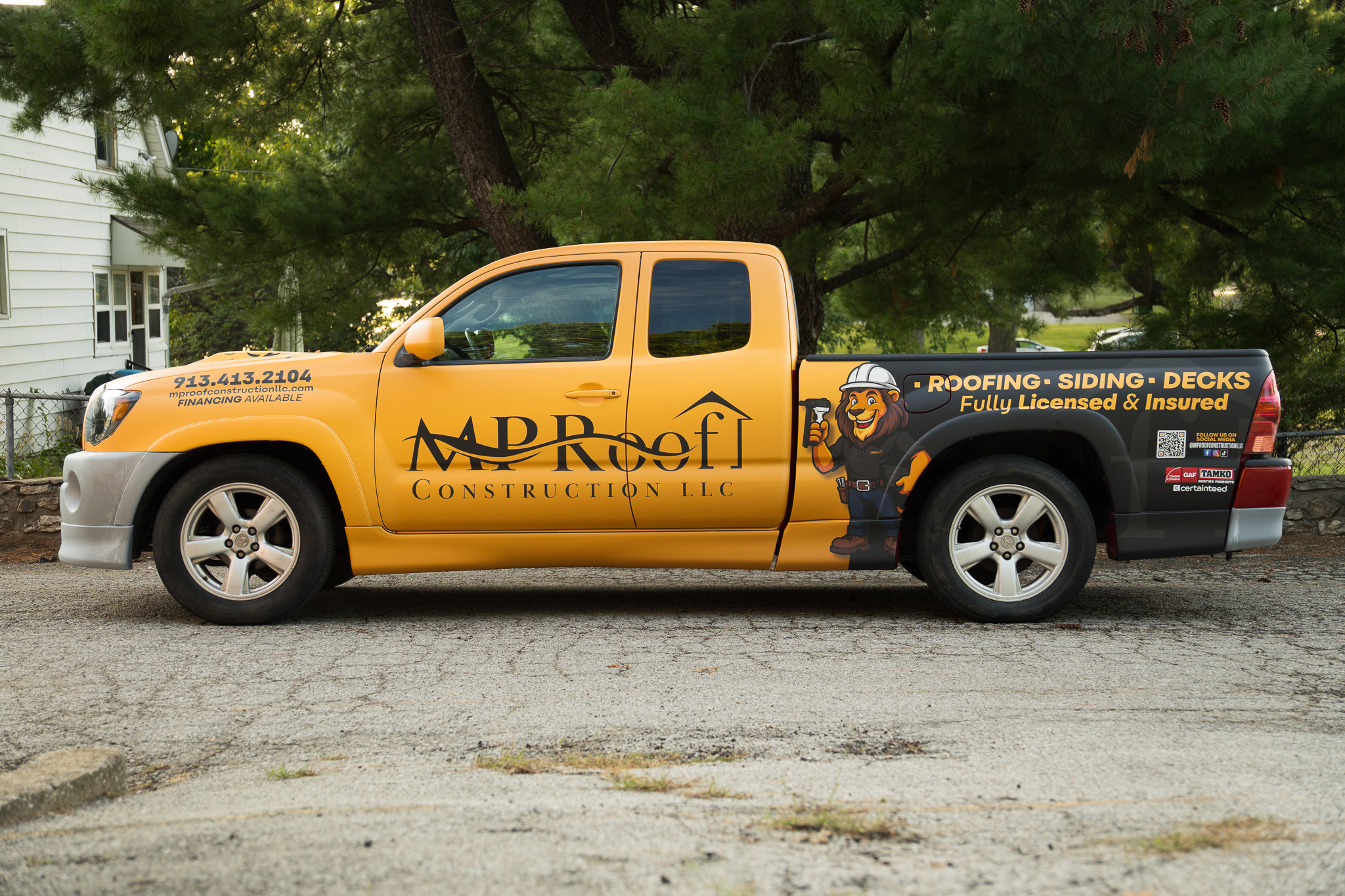
The graphic designer job market is built around a digital-first world. Most roles listed today emphasize social media graphics, email campaign assets, web design, and brand identity decks. That skill set is genuinely valuable, but it does not automatically translate to the work a growing Kansas City business actually puts in front of customers every day: vehicle wraps, wide-format event signage, screen-printed apparel, and commercial print production. These are physically demanding, technically specific disciplines, and a designer shaped by agency or tech-brand environments often arrives without fluency in them.
Consider the realistic growth arc of a business in the Kansas City metro. A new brand might need a logo this week, business cards and stationery shortly after, a trade show banner next month, and a partial fleet wrap before the end of the quarter. That sequence is not unusual; it reflects how businesses actually build visibility over time. Staffing that range through a single in-house hire is genuinely difficult. A designer with strong digital skills may struggle with print file specifications, and a production-focused print technician may not bring the strategic brand thinking the logo stage requires. The two disciplines are related, but they are not the same.
For businesses serving Kansas City’s Hispanic community, the design stakes go further still. Bilingual marketing materials are not simply a translation task assigned to a competent technician. Effective culturally informed design requires genuine familiarity with the audience, including visual culture, color associations, and community-specific messaging norms. A creative partner who understands that context brings something a job description cannot capture.
Production errors in wide-format and print work carry real consequences. A wrong color profile or missing bleed on a vehicle wrap does not cost one click or one revision; it can mean a full reprint and a missed installation window. Production-ready design at Kansas City print operations is described as non-negotiable, with roles that are 80% project coordination and only 20% actual design work. That ratio reflects where complexity accumulates when multiple vendors and formats are involved.
When a business owner coordinates separately between an in-house designer, a commercial printer, a sign vendor, and an apparel decorator, every handoff introduces risk: file format mismatches, inconsistent brand color reproduction across substrates, and accountability gaps when something goes wrong. Fewer handoffs mean more consistent results and a cleaner use of time and budget.
The Alternative: A Full-Service Creative Studio Under One Roof
There is a simpler path forward, and it does not require a job posting, a 44-day hiring window, or a stack of onboarding paperwork.
A full-service creative studio brings graphic design, wide-format printing, vehicle wraps, business stationery, apparel printing, web development, and promotional products together as a single integrated team. According to research on design service models, 48% of CEOs are already planning to increase external and flexible creative partnerships rather than grow fixed headcount. That shift reflects something small business owners across Kansas City already understand intuitively: paying for what you need, when you need it, is more sustainable than carrying overhead you may not use every week.
The economics support this clearly. Design agencies typically operate with profit margins of 15 to 25%, a reflection of how efficiently a multi-client model spreads software, hardware, and talent costs. Compare that to the fully loaded first-year cost of a single mid-level in-house hire, which research places at $90,000 to $140,000 when you factor in salary, payroll taxes, benefits, software licensing, hardware, and recruiting. If that hire leaves, the clock resets: a new search, another 44-day vacancy, and another round of onboarding. A studio partnership carries none of that disruption risk. The work simply continues.
Studies comparing design service approaches also confirm that no single in-house designer can realistically cover the full range of skills a growing business needs, from brand identity and print production to web development and signage. When your pipeline depends on one person, it stalls the moment that person is unavailable.
GTN Studio, based in Kansas City and serving the broader metro including Overland Park, Olathe, and Shawnee Mission, was built specifically to solve this problem for small and growing businesses. With over 200 completed projects and a 5/5 customer rating, the studio brings a proven track record that no new hire can offer on their first day. For businesses in Kansas City’s Hispanic community, that relationship goes deeper still: bilingual, culturally grounded creative work is part of the conversation from the beginning, not a correction added at the revision stage.
Perhaps most importantly, working with a local studio means one real team handles every stage, from the initial concept through physical production and on-site installation. There are no offshore handoffs, no platform intermediaries, and no gap between what looks right on screen and what actually goes on your vehicle, your storefront, or your event banner.
Hire vs. Outsource: Making the Right Call for Your Business
Answering the hire-versus-outsource question requires more than comparing a salary figure to an hourly rate. It requires an honest look at how your business actually uses design, and how much creative capacity you realistically need on any given week.
In-house hiring makes strong sense in one specific scenario: when your design workload is high-volume, daily, and tightly integrated with internal operations. A large marketing department producing dozens of campaign assets per week, with consistent brand oversight and a dedicated creative director, can justify the salary, benefits, equipment, and management overhead that come with a full-time designer. For those organizations, deep brand immersion and immediate availability justify the investment.
For most small and growing businesses across Kansas City, Overland Park, and Olathe, that scenario does not apply. Design needs tend to be project-driven and varied: a new logo one month, vehicle wrap graphics the next, event signage before a trade show, updated business cards after a rebrand. A salaried designer on staff during quiet periods still draws a full paycheck, and the fully-loaded cost of that position, including payroll taxes, benefits, and software licenses, typically runs well above the base salary figure alone. Flexibility has real financial value, and a studio relationship scales with your actual workload rather than against it.
Freelance platforms and remote designers offer an appealing hourly rate, typically $45 to $75 per hour for generalists, but that number does not reflect the time spent vetting candidates, onboarding them to your brand, or managing reliability risks. More importantly, a remote freelancer sourced through an online platform cannot provide local market knowledge, integrated print production, or the concept-to-installation continuity that keeps your brand consistent from your website to your vehicle wraps to your trade show booth. Physical and digital touchpoints require coordination, and that coordination is difficult to achieve across disconnected vendors.
There is also a structural reality worth acknowledging: staffing firms actively recruit Kansas City-area designers on behalf of large corporations with significant compensation packages. Small businesses are competing against well-resourced employers for the same limited local talent pool, and that competition extends hiring timelines considerably.
The more useful question is not simply what a designer costs, but what reliable, full-spectrum creative capability costs, and what the most flexible path to that capability looks like as your business grows. For many Kansas City businesses, the case for outsourcing graphic design comes down to accessing broader expertise without the overhead of employment. A studio partnership built around your actual project rhythm, handled by a team that knows your brand and can take work from concept through printing and installation, is often the most efficient structure available.
The Bottom Line for Kansas City Business Owners
The numbers tell a clear story. A mid-level graphic designer in Kansas City carries a base salary of $69,604 to $82,283 according to current 2026 hiring data, and once you layer in payroll taxes, health insurance, paid time off, and other standard employer costs, that figure climbs into the $87,000 to $95,000+ range annually, before a single software license or workstation is purchased.
In-house hiring does make sense for some businesses. If your operation generates consistent, high-volume design work with a stable brand direction and the operational infrastructure to support a full-time employee, that investment can pay off. Most small and growing businesses in Kansas City, Overland Park, and Olathe are not in that position, and committing to that overhead before you are ready carries real risk.
For the majority of local business owners, the practical answer is a creative partner who can move with you from concept through production and installation, without the fixed costs, the 44-day hiring window, or the management overhead. That is exactly what GTN Studio is built to do. From logo design and business cards to vehicle wraps, signage, and branded apparel, every project is handled locally with the hands-on attention your business deserves.
If you are ready to build your brand without the complexity of hiring, we would love to have a no-pressure conversation. Reach out to the GTN Studio team in Kansas City and let us show you what a dedicated creative partner can do for your business.
Conclusion
Understanding the real cost of graphic design talent puts Kansas City small businesses in a stronger position to grow. Here are the key takeaways to keep in mind:
First, hourly rates and salaries only tell part of the story; benefits, software, and overhead can significantly increase your total spend. Second, freelancers and agencies each offer distinct financial advantages depending on your current stage of growth. Third, hidden costs are avoidable when you plan ahead and ask the right questions before signing any agreement.
Now is the time to audit your current design spending and compare it against the models outlined here. Download our free Kansas City Design Budget Worksheet to map out your true costs before your next hire.
Smart spending on creative talent is not just possible; it is one of the most strategic investments your business can make.