So you’ve got a small business and you’re thinking about custom merchandise, uniforms, or branded gear. Maybe you’ve heard the term “screen printing” thrown around, but you’re not quite sure if it’s the right fit for your needs or your budget. You’re not alone!
Screen printing is one of the most popular methods for putting designs on clothing and other products, and for good reason. It produces vibrant, long-lasting results that can make your brand look seriously professional. But is it the best choice for a small business just getting started? That depends on a few important factors.
In this post, we’re breaking down everything a beginner needs to know about screen printing, including how it works, how it compares to other printing methods, and what to consider before placing your first order. By the time you’re done reading, you’ll have a clear picture of whether screen printing makes sense for your business, your budget, and your goals. Let’s dig in and take the mystery out of it!
How Screen Printing Works (In Plain Language)
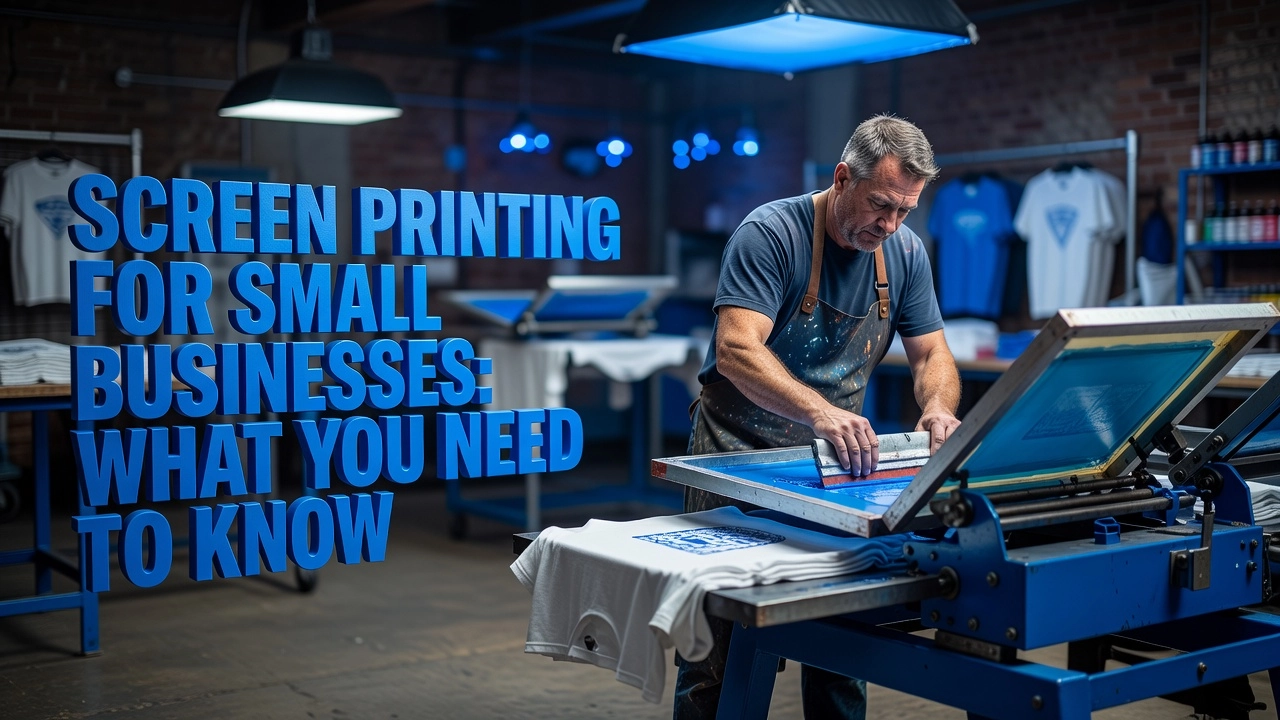
Screen printing is one of those processes that sounds complicated until someone breaks it down for you. At its core, it works like this: a stencil is created on a fine mesh screen, ink is pushed through the open areas of that stencil using a squeegee, and the result bonds directly to the surface below. The outcome is a print that’s vivid, opaque, and built to last through repeated washing and everyday wear, which is exactly why it remains a go-to choice for business apparel, branded merchandise, and promotional items.
From Artwork to Finished Product
The production process follows a clear sequence. First, your artwork is prepared and separated by color, because each individual color in your design requires its own dedicated screen. A three-color logo means three screens, each precisely aligned on the press. The screens are coated with a light-sensitive emulsion, exposed to UV light to “burn” your design into the mesh, and then rinsed to reveal the open stencil. From there, ink is applied and a squeegee pushes it through onto your garment or substrate. Finally, heat is applied in a curing stage that fully fuses the ink to the material, which is what gives screen printed items their lasting durability. You can learn more about how the screen printing process works step by step if you want to dig deeper.
Why Spot Color Matters for Your Brand
If your business has a specific logo color, spot color printing is your best friend. Instead of blending dots of ink to approximate a color, each shade is mixed to an exact standard before it ever touches the screen. If your brand uses a specific Pantone color, it can be matched precisely and reproduced consistently across every single item in your order. For small and growing businesses in Kansas City, Overland Park, or Olathe building brand recognition, that consistency across your team uniforms, tote bags, and promotional giveaways matters more than most people realize.
More Than Just T-Shirts
Screen printing works on a wide range of surfaces beyond apparel. Posters, tote bags, hoodies, hats, and a broad selection of promotional products can all be printed using this method, along with paper, wood, and certain plastics. At GTN Studio, we handle all of these, so whether you need staff shirts for an event or branded items for a trade show, the same reliable process applies.
The best part? While the behind-the-scenes work involves chemistry, UV exposure, and careful registration, none of that complexity lands on your plate. Your experience as a client comes down to three simple steps: submit your artwork, approve a proof, and receive your finished products. The technical side is handled entirely by our team, so you can stay focused on running your business.
What Screen Printing Is Best For
So now that you know how screen printing works, the bigger question is whether it’s the right fit for what you actually need. The good news is that screen printing is one of the most versatile print methods out there, and it shines brightest in a handful of very specific situations.
Staff Uniforms and Team Apparel
If you run a restaurant, a landscaping crew, a cleaning service, or a retail shop in the Kansas City area, matching uniforms do more than look sharp. They signal professionalism to every customer who walks through your door or sees your team on the job. Screen printing is the go-to choice here because it produces bold, consistent results across every shirt in the order. Whether you need 15 polo shirts for your front-of-house staff or 50 t-shirts for a construction crew, every single piece comes out looking exactly the same. That kind of consistency builds trust with your customers and pride within your team.
Event Merchandise and Community Celebrations
Think about the last festival, fundraiser, or family reunion you attended. Chances are, those custom t-shirts were made using screen printing. It is the preferred method for events because you can print one design across hundreds of shirts quickly and affordably. From Olathe community fairs to Kansas City nonprofit fundraisers and local sports leagues, screen printing makes branded event merchandise accessible without breaking the budget. Cultural celebrations, school events, and neighborhood gatherings all benefit from the kind of vibrant, eye-catching results that screen printing consistently delivers.
Trade Show Giveaways and Grand Opening Promotions
Branded giveaways are one of the smartest ways to get your name in front of new customers, and screen printed products have real staying power. A well-made t-shirt, tote bag, or cap handed out at a trade show or grand opening keeps your brand visible long after the event is over. These are items people actually use, which means your logo stays in rotation in daily life around the Kansas City metro.
Bulk Orders Where Consistency Is Non-Negotiable
Screen printing is structurally built for volume. Once the screen is set up, it prints the same design with zero variation across every item in the run. This matters tremendously when you need an entire crew in matching apparel or merchandise stocked on a storefront shelf. The advantages of screen printing at scale are hard to overstate; color saturation stays rich and uniform whether you are printing 24 shirts or 240.
Apparel That Needs to Last
Screen printed ink goes through a heat-curing process that bonds it directly to the fabric fibers, making designs significantly more resistant to fading, cracking, and peeling over time. If your team wears their shirts daily in demanding conditions, whether in the field, the kitchen, or out on a job site, that durability matters. This is not decorative printing meant to look good for a season. It is built to hold up through repeated washes and heavy use, which is exactly what working businesses need from their branded apparel.
Screen Printing vs. Embroidery: Which Is Right for You?
If you’ve been shopping around for custom apparel, you’ve probably wondered whether screen printing or embroidery is the better choice for your brand. The honest answer is that neither method is universally better; the right choice depends on your garment, your design, and what impression you want to make. Understanding the core difference between the two helps a lot.
Screen printing pushes ink through a mesh screen directly onto the surface of the fabric. The result is a flexible, vibrant print that sits close to the garment and really pops visually. Embroidery works in the opposite direction, stitching colored thread directly into the fabric itself. That creates a raised, textured finish that feels premium in your hands and reads as polished and professional at a glance. Same logo, very different outcome depending on which method you choose.
When Screen Printing Is the Right Call
Screen printing shines when your goal is bold, high-impact visuals at a reasonable cost. Think event T-shirts, volunteer crew shirts, full-chest graphics, promotional giveaways, and anything where a strong visual statement is the priority. Large multi-color designs translate beautifully to screen printing because the process handles big coverage areas and vibrant colors exceptionally well. For businesses in Kansas City running a community event, launching a seasonal campaign, or outfitting a team for a trade show, screen printing is often the most practical and cost-effective path, especially when order quantities are higher. The per-unit cost becomes very manageable once you’re ordering enough pieces to spread the setup cost across the run.
When Embroidery Is the Right Call
Embroidery earns its place the moment professionalism becomes the priority. Polo shirts, structured caps, softshell jackets, button-down uniforms, and corporate gifts all look significantly sharper with embroidered branding. There’s a real visual difference between a logo screen printed on a polo and that same logo stitched into the fabric; embroidery simply communicates quality in a way that ink on a polo shirt can’t quite match. For client-facing staff in Overland Park or Olathe, or for businesses creating branded gifts that represent their company, embroidery is usually the stronger choice. It’s also worth noting that hats are essentially a screen-printing-free zone since the curved surface makes ink application impractical; embroidery vs. screen printing comparisons consistently point to embroidery as the only reliable option for caps.
The Cost Reality
Screen printing typically offers better economics at volume for designs with a limited number of colors. Embroidery pricing scales with stitch count rather than color count, so a detailed, large design can add up quickly per piece. A simple chest logo sits in a manageable range, but a complex full-back design can be significantly more expensive to embroider than to screen print.
The good news for business owners in the Kansas City area is that you don’t have to figure this out alone. GTN Studio offers both screen printing and embroidery, and the team can walk you through which method makes the most sense for your specific garment, design, and budget, all without having to visit multiple vendors or piece together advice from different sources.
Screen Printing vs. DTF and Heat Transfer: Understanding Your Options
If you’ve spent any time shopping for custom shirts online, you’ve probably noticed platforms advertising “no minimums” and “no setup fees.” Before you place that order, it helps to understand what’s actually happening behind the scenes, because those offers usually involve a different printing method than screen printing. Knowing the difference can save you from a frustrating surprise when your shirts arrive.
What DTF and Heat Transfer Actually Are
DTF (Direct-to-Film) is the newer technology behind most of those low-minimum online offers. A design is digitally printed onto a thin plastic film using CMYK ink plus a white base layer, coated with adhesive powder, cured, and then heat-pressed onto your garment in one step. There are no screens to burn and no color-by-color setup, which is exactly why platforms can offer single-piece orders at a low entry price. Think of it as a very high-quality, flexible sticker bonded to the fabric. Heat Transfer Vinyl (HTV) is a related but different product. With HTV, sheets of colored vinyl are cut into shapes by a machine, the excess is removed by hand, and then the design is heat-pressed onto the garment. Both methods sit on top of the fabric rather than soaking into it, which matters when we talk about durability and feel.
Where DTF and Heat Transfer Make the Most Sense
DTF genuinely shines in specific situations, and there is no reason to pretend otherwise. If you need one to five pieces, a full-color photographic design, or a personalized item on a tight deadline, DTF is often your best practical option. It handles unlimited colors, gradients, and photo-realistic artwork in a single pass, something that screen printing simply was not designed to do at small quantities. Turnaround times for DTF can be same-day to three days in many cases. For a business owner in Olathe or Overland Park who needs a handful of branded shirts for a weekend pop-up, that speed and flexibility is genuinely useful.
Where Screen Printing Still Wins
Once your order reaches 12 or more pieces, especially with bold one or two-color designs, screen printing becomes the stronger choice on almost every measure. Because the ink is pushed directly into the fabric rather than layered on top, you get a softer feel, richer color saturation, and a print that holds up beautifully through repeated washing. For businesses ordering staff uniforms, event merchandise, or branded workwear across the Kansas City metro, those qualities matter more than convenience at tiny quantities. The per-unit cost also drops meaningfully as your order grows, making screen printing the smarter investment for anything you plan to wear, sell, or hand out regularly.
The Hybrid Trend Worth Knowing About
One of the more interesting developments heading into 2026 is the rise of hybrid decoration, where multiple methods are combined on a single garment. A shirt might feature screen-printed puff ink for a raised dimensional logo, a DTF panel for a full-color photographic graphic, and HTV lettering for a name or number. This approach is growing because it lets designers achieve effects that no single method can deliver alone. According to a 2026 comparison of DTF vs. screen printing, the right method often depends on the specific application rather than a blanket rule. A local shop that works with multiple technologies, like GTN Studio here in Kansas City, can look at your design and help you figure out when combining methods actually makes sense for your project.
The Honest Bottom Line
Neither screen printing, DTF, nor heat transfer vinyl is universally better. The right choice comes down to four things: how many pieces you need, how complex your design is, what kind of garment you are printing on, and how long you need the print to last. Industry analysis for 2026 consistently shows that small quantities and complex artwork favor DTF, while larger runs with bold graphics favor screen printing. The most practical advice for any small business owner is to share your full picture with a local print partner who can walk you through the tradeoffs honestly, rather than defaulting to whatever an online platform makes easiest to click.
What to Expect: Minimums, Pricing, and Turnaround Time
One of the first practical questions new buyers ask is: “How many do I need to order?” With screen printing, the honest answer is that most shops work with a minimum of 12 to 24 pieces per design to make the process cost-effective. This isn’t about shops turning away small orders for fun; it’s about economics. Before a single shirt gets printed, screens have to be burned and registered for each ink color in your design. That setup work takes real time and skill, and those fixed costs exist whether you’re printing 10 shirts or 100. When that overhead is spread across too few pieces, the per-unit price stops making sense for anyone. If you’re working with a quantity under 12, it’s worth asking your print shop about alternatives like DTF transfers, which carry no minimums and work beautifully for very small runs. You can learn more about screen printing minimum orders and what drives them to understand the logic before you call.
Pricing in screen printing follows a straightforward logic once you understand the two main variables: quantity and ink colors. As your order size goes up, your per-unit cost goes down because those fixed setup costs are divided across more pieces. A run of 50 shirts will always cost less per shirt than a run of 12, all else being equal. The number of colors in your design matters just as much; each color requires its own separate screen, so a three-color logo costs more to set up than a single-color design. Print locations also factor in, meaning a design on the front only will generally cost less than front and back combined. The top screen printing questions answered by industry pros give a solid overview of how these variables interact. One thing worth knowing: if your artwork isn’t in vector format and needs to be converted before production can begin, an art preparation fee may apply. A quick heads-up when you reach out can save everyone time.
For turnaround, plan on 7 to 10 business days from the date your artwork is approved, not from the date you first reach out. That distinction matters more than most buyers realize. The production clock does not start until artwork is finalized, payment is confirmed, and all order details are locked in. Rush production may be available depending on order complexity and current workload, though it typically comes with an additional fee, and very complex or large orders may not qualify at all.
This is where planning ahead makes a real difference. If you’re ordering shirts for a grand opening in Overland Park, a fall sports season, a local festival in Olathe, or a business anniversary event, get your artwork submitted as early as possible. A good rule of thumb: if your event is October 1st, aim to have artwork approved by mid-September at the latest. Seasonal peaks fill production schedules quickly, and submitting early gives you breathing room if revisions are needed.
Working with a local shop like GTN Studio in Kansas City means you have an actual person to call when questions come up. Automated online platforms process your order and move on; they won’t flag artwork resolution problems, ask whether your color count could be simplified to save you money, or check whether your deadline is realistic given current shop capacity. A real conversation at the start of your project can catch those details before they become expensive surprises, and that kind of hands-on attention is something a checkout button simply cannot replicate.
Why Kansas City Businesses Choose a Local Print Partner
There is a real difference between uploading files to a website and actually working with someone who knows your business, understands your goals, and picks up the phone when you have a question. That difference becomes especially clear when something needs to be adjusted before production starts.
The Hands-On Review That Saves You Time and Money
When you bring your project to a local shop, a real person looks at your artwork before anything gets printed. At GTN Studio, that means someone is checking your file resolution, flagging colors that might not transfer cleanly to fabric, and asking the right questions about garment type and placement before a single screen is burned. That kind of pre-production attention catches problems early, when fixing them is simple and free, rather than after a full run has already been completed. You get direct communication throughout the process, not automated status emails with no one to call if something feels off.
Bilingual Service, Because Language Should Never Be a Barrier
GTN Studio proudly serves the Hispanic business community across the Kansas City metro, and bilingual support is a core part of how we work. For Spanish-speaking business owners in Kansas City, Overland Park, and Olathe, being able to communicate clearly about design choices, fabric options, and order details in your preferred language is more than a convenience; it is the difference between a result you love and one that misses the mark. Building a brand is personal work, and that conversation should feel comfortable and clear from the first inquiry to the final pickup.
Geographic Convenience Across the KC Metro
For businesses throughout Overland Park, Olathe, Shawnee Mission, and the broader Kansas City area, working locally removes a layer of friction that online-only platforms simply cannot eliminate. You can stop in to review a physical sample before committing to a full run, drop off materials without coordinating around carrier schedules, and pick up finished orders on your timeline. Local print partners in Kansas City are embedded in the same business community as their clients, which means your deadlines matter to them the same way they matter to you.
A Stake in Your Success
A locally owned shop builds its reputation order by order, neighbor by neighbor. Whether you are running a family restaurant in Overland Park, managing a construction crew out of Olathe, or putting together merchandise for a nonprofit event in Kansas City, GTN Studio has a genuine interest in seeing your project succeed. The custom print sector is projected to grow at a strong CAGR through 2033, and businesses that combine real print expertise with hands-on client relationships are positioned to serve that demand in ways that automated national platforms simply cannot replicate. When you work local, you are not a ticket number; you are a neighbor.
Industries and Use Cases GTN Studio Serves
Screen printing touches more industries than most people realize, and if you’re a business owner or community organizer in the Kansas City area, there’s a good chance it has a practical place in your world. Here’s a look at who GTN Studio works with and how custom apparel actually fits into the bigger picture for each group.
Restaurants and Food Service
A well-dressed team communicates something important before a single word is spoken. For restaurants, cafes, food trucks, and catering operations across Kansas City, branded staff shirts, aprons, and event uniforms signal professionalism and consistency to every customer who walks through the door. Whether you’re running a single neighborhood spot or expanding to multiple locations in Overland Park or Olathe, screen-printed apparel keeps your team looking cohesive without requiring a massive investment. The commercial application segment held over 52% of the custom t-shirt printing market in 2025, reflecting just how central branded apparel has become for customer-facing businesses in hospitality and food service.
Construction and Trades
Job site apparel has to work as hard as the people wearing it. For contractors, plumbers, electricians, landscapers, and general trades professionals across the Kansas City metro, durable crew shirts and high-visibility safety apparel are practical necessities. But they’re also a form of moving advertisement; every time your crew shows up to a residential neighborhood in Shawnee Mission or a commercial build in Olathe, your brand is visible to potential customers passing by. Construction consistently ranks among the top industries purchasing promotional apparel, and for good reason. A unified team in well-branded gear builds trust before the work even starts.
Community Organizations and Nonprofits
From church fundraisers and neighborhood associations to youth sports leagues and local nonprofits, community groups across Kansas City rely on affordable, high-quality printed shirts to bring their people together. Event t-shirts double as walking advertisements for a cause, and volunteer uniforms help identify staff and create a sense of shared purpose at large gatherings. Screen printing is especially well-suited for these larger uniform and event runs where consistency in color and design really matters.
Cultural Celebrations and Family Events
Some shirts are worn once. Others get folded up and kept for years. Custom apparel for quinceañeras, family reunions, graduation parties, and milestone birthdays falls into that second category. These pieces carry real sentimental weight, and the care that goes into designing and printing them should reflect that. GTN Studio understands the meaning behind these celebrations, particularly within the Hispanic community in Kansas City, and approaches each order with that same attention to detail.
Retail and Promotional Merchandise
For retail storefronts, pop-up markets, and trade show appearances throughout the Kansas City metro, branded merchandise and promotional giveaways extend your reach well beyond the event itself. The U.S. promotional products industry reached $26.78 billion in total sales in 2024, with apparel consistently ranking as the top-performing category. GTN Studio’s advantage here is that branded shirts, business cards, stationery, and promotional products can all be handled under one roof, keeping your branding consistent and your process simple. If you want a deeper look at what’s trending in promotional merchandise, VistaPrint’s 2026 promotional products guide is a solid starting point for ideas before you meet with your print partner.
Getting Your Artwork Ready for Screen Printing
Before a single screen gets coated or a squeegee pushes ink across fabric, your artwork needs to be ready for production. This is one of the most overlooked steps in the screen printing process, and it’s where a lot of first-time orders run into trouble.
File Format Matters More Than You Think
The gold standard for screen printing artwork is a vector file, typically saved as an AI (Adobe Illustrator), EPS, or print-ready PDF. Unlike a photo or a PNG pulled from a website, vector files are built from mathematical paths rather than tiny colored squares. That means your logo can scale from a small left-chest print to a large back graphic without losing a single sharp edge. Just as importantly, vector files make it straightforward to separate each ink color onto its own screen, which is exactly how the screen printing process works. One color, one screen. Clean separation leads to clean results.
If you only have a low-resolution image saved from your Facebook page or a blurry JPEG from an old business card, that file is likely going to cause delays. Industry experience shows that roughly 30% of artwork submitted to print shops requires corrections before production can begin, not because the designs are bad, but because the files simply are not set up correctly. You can review practical artwork and print file preparation guidelines to get a sense of what professional files look like before you submit.
Design Details That Affect the Final Print
A few technical thresholds are worth knowing before you finalize your design. Text smaller than 8 points tends to fill in or become illegible once it hits fabric. Thin lines under 1 point struggle to hold ink consistently. And if your design relies on very dark colors printed on a dark shirt, an additional white underbase layer is typically required, which adds a step to the process. Colors that look vivid on a backlit monitor can also shift when converted for print, so working in spot colors rather than RGB gives you the most reliable results.
For a deeper look at how to structure your file correctly, this complete guide to preparing artwork for screen printing walks through the key technical steps in plain language.
No Professional Artwork? That’s What We’re Here For
Not having production-ready files is one of the most common barriers small business owners face, and it does not have to stop your project. The in-house graphic design team at GTN Studio works with clients across Kansas City, Overland Park, and Olathe to build or refine artwork until it is fully ready for print. Whether you need a logo created from scratch or an existing design cleaned up and converted to a proper vector file, that support is available right here, without sending your project to a separate vendor.
Proofs Protect Everyone
Before any ink touches a garment, GTN Studio provides a pre-production proof for your review and approval. This is your opportunity to confirm placement, sizing, color, and layout before production begins. It is a simple step that prevents expensive surprises and keeps the whole process moving forward with confidence.
If your business does not yet have a consistent brand identity, screen printed apparel is actually a great reason to build one. Starting with graphic design means your shirts, business cards, signage, and digital presence all share the same visual language, which makes your brand feel polished and intentional from day one.
Ready to Put Your Brand on Something That Lasts?
When it comes to putting your brand on apparel and promotional items that actually hold up over time, screen printing remains one of the smartest choices a small business can make. The colors stay vivid, the prints survive wash after wash, and the cost per piece drops significantly when you’re ordering in volume. Whether you’re outfitting a team, preparing for a community event, or building a merchandise line, screen printing delivers consistent, professional results that reflect well on your brand long after the order ships.
That said, choosing the right method, preparing your artwork correctly, and planning your timeline are all steps that go a lot smoother with a knowledgeable partner in your corner. Working with a local print shop means you get real guidance, not just a checkout cart.
At GTN Studio, we work with small and growing businesses across Kansas City, Overland Park, Olathe, and Shawnee Mission to make the entire process straightforward and stress-free. Screen printing is just one part of what we offer; we also handle embroidery, graphic design, promotional products, business stationery, and more, all under one roof. No juggling vendors, no guesswork.
If you’re ready to put your brand on something built to last, we’d love to have a no-pressure conversation about your project. Reach out to GTN Studio and let’s figure out the best path forward together.
Conclusion
Screen printing can be a powerful tool for small businesses ready to make their brand stand out. To recap the key takeaways: screen printing delivers vibrant, durable results that look professional; it works best for larger order quantities where the cost per item decreases significantly; and it outperforms many other methods when you need bold, long-lasting designs on apparel or merchandise.
Now that you understand the basics, the process, and what to consider before ordering, you’re equipped to make a smart decision for your business. Ready to take the next step? Reach out to a local or online screen printer for a quote, ask about minimum order requirements, and share your vision. Your brand deserves to be seen. Start building that recognition today, one great-looking shirt at a time.